
A lot has happened since my update last month.
The war in Iran has escalated, an end to the war is looking less and less likely any time soon. There was a hope the war would have ended by now, unfortunately that has not happened and so I think even the most optimistic Economists are accepting that inflation might be more likely to bed in rather than be a short term thing.
This has lead to suggestions of up to 4 rate rises in the next 2 years! My personal view is that this is unlikely but we all have to make those decisions for ourselves.
What mortgage rates we are looking at?
As ever, we always look at the same 4 scenarios for some consistency. The 4 scenarios are:
- 2 year deal at 90% LTV with a £999(ish) fee.
- 5 year deal at 90% LTV with a £999(ish) fee.
- 2 year deal at 85% LTV with a £999(ish) fee for adverse*
- 5 year deal at 85% LTV with a £999(ish) fee for adverse*
*Adverse in these examples is someone with 5 defaults from 2 years ago. Enough to mean we cant go to the high street.
Some of these lenders would not have actually accepted the adverse, some only lend in certain areas and some have large fees. When we put the rates below, we go with the ones we know are likely to accept the majority of people. That means there may actually be lower rates available on the market.
What mortgage rates are available now?
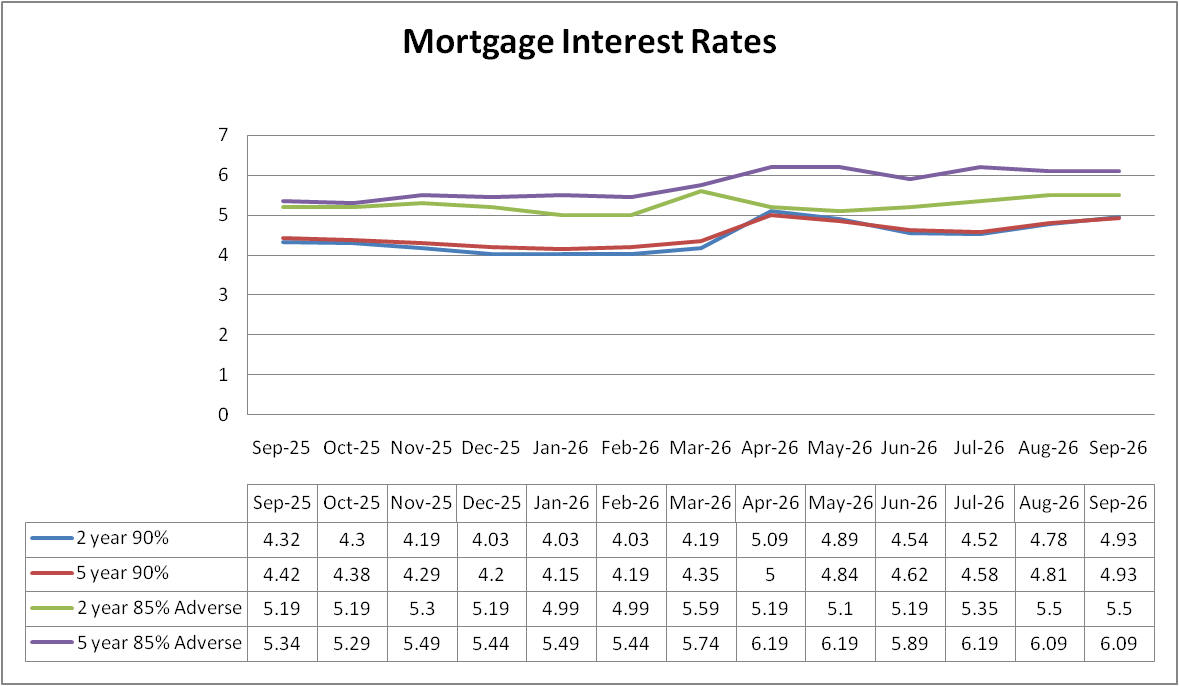
Mainstream rates are on the rise again, we are still not quite at the peak we seen in April this year, but we are very close and I think it is safe to say by the next update we probably will be much closer again.
Regarding the adverse credit market, recent discussions with account managers reveal that funding is typically allocated in tranches, which contributes to more stable rate movements. However, as lenders exhaust their current funding and seek additional capital, adverse credit rates are expected to rise accordingly.
Mortgage rates in 2026
I think you can probably guess what we think is on the cards for the rest of the year with the last section. There Two dominant factors are currently influencing interest rate decisions:
- Geopolitical tensions involving Iran, which represent the most significant variable.
- The UK’s unemployment figures, which have recently exceeded expectations. While a stronger economy is generally positive, it also constrains the Bank of England’s ability to raise rates without risking job market stability.
The Bank of England faces a complex balancing act, controlling inflation without undermining employment levels. Given these dynamics, it is highly probable that the base interest rate will increase in the near term, potentially as soon as the upcoming review this week.
Summary
The coming months are poised to present challenges for borrowers. Although mortgage rates have been elevated at various points over the past three years—particularly following the mini-budget—current trends suggest that rates will soon approach those previous highs once again.